
Drain Field Repair: Signs, Causes and Your Options in South Florida
Florida's septic rules measure drain fields against the "wet season high water table," and for good reason. In much of Miami-Dade and Broward, groundwater sits only a few feet down, and a drain field (also called a leach field) has to do its job in that narrow layer of soil. When it stops absorbing water, the problem usually shows up in the yard first: soggy ground, odors, or grass that stays green when everything else is dry. Drain field repair starts with finding out why the field is struggling, because the fix depends on the cause.
A failing drain field usually shows up as standing water, sewage odors or spongy, extra-green grass over the field, often with slow drains in the house. Common causes are solids escaping from a tank that hasn't been pumped, high groundwater, tree roots, compacted soil, too much water, and an old or undersized system. Some problems can be fixed by correcting the cause; others need part or all of the drain field replaced. In Florida, a repair permit is required before work on the system begins.
What a drain field does
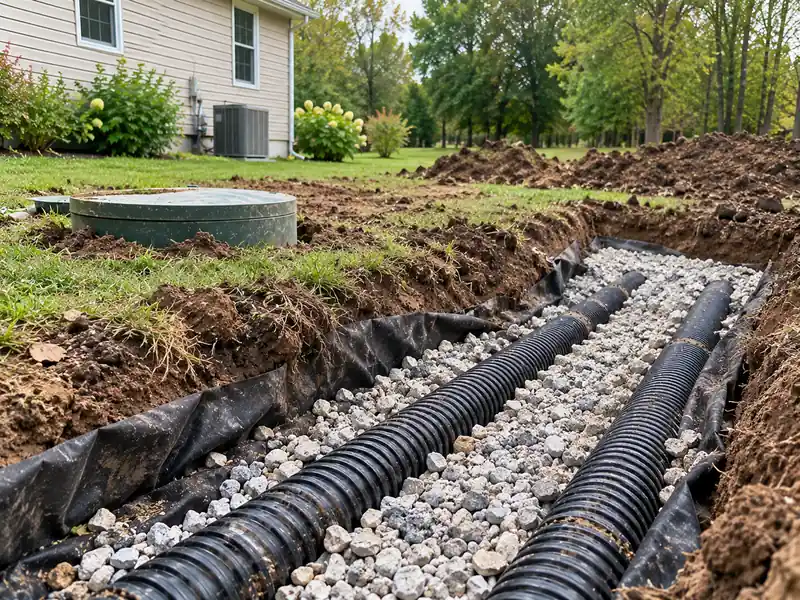
Wastewater from your house flows into the septic tank, where solids settle to the bottom and grease and scum float to the top. The liquid in the middle flows out to the drain field, a set of perforated pipes or chambers buried in gravel or soil. The soil filters and treats that water as it soaks in. If the soil can't absorb it, the water has nowhere to go but up to the surface or back toward the house.
Signs your drain field may be failing
The EPA lists these as signs of a malfunctioning system:
Standing water or damp spots near or over the septic tank or drain field
Bright green, spongy, lush grass over the drain field, "even during dry weather"
Sewage odors around the tank or drain field
Soft, wet or spongy soil when there hasn't been significant rain
Inside the house, you may also notice slow drains in several fixtures at once, gurgling pipes, or a backup in the lowest drains. Source: U.S. EPA, Resolving Septic System Malfunctions.
Is it the drain field or the tank?
Several of these signs can also come from a full tank or a clogged line, so the first step is to rule those out. If the tank is overdue, a pump-out may be enough. If the outlet baffle or effluent filter is blocked, clearing it can restore flow. Our article on common causes of septic backups walks through how to tell these problems apart.
The drain field is the likely cause when the tank has been pumped and the outlet is clear, but water still surfaces over the field or backs up again soon after. A septic tank inspection is the way to confirm it before deciding on repairs. For more on what an inspection can and can't show, see can a septic inspection detect drain field problems.
Common causes of drain field problems
Solids escaping from the tank
The EPA notes that when routine maintenance is skipped, "solids in the tank" can "migrate into the drain field and clog the system." Once sludge and scum reach the field, they coat the soil and gravel and slow absorption. This is the most preventable cause, and it's why pumping on schedule protects the drain field as much as the tank. Our post on how dirty septic tanks lead to drain field failures covers this in detail.
High groundwater
The EPA lists "high ground water tables" among the site conditions that cause drain field systems to malfunction. In South Florida, Miami-Dade County notes that groundwater is "just a few feet beneath the surface" and usually closest to the surface at the end of the wet season, around September and October. A drain field that works in spring can struggle late in the rainy season or after a heavy storm, simply because the soil is already full of water. Source: Miami-Dade County, Connect 2 Protect.
Tree roots
Roots grow toward water and can work their way into drain field pipes, blocking flow or breaking the lines. Trees and large shrubs planted close to the field are the usual source.
Compacted soil
Parking cars, driving equipment or building over the drain field presses the soil down and reduces how much water it can absorb. Wet soil compacts more easily, so traffic over the field during the rainy season does more damage.
Too much water
Running toilets, leaking fixtures, back-to-back laundry and gutter downspouts aimed at the field can all send more water through the system than the soil can handle.
Age or design
The EPA notes that "most septic systems malfunction because of inappropriate design or poor maintenance," and that some drain fields are installed in poor soils or where the water table is high. An older field, or one that was undersized for the home, may simply have reached the end of its useful life.
Drain field repair options
What can be done depends on what's wrong and how far the damage has gone.
Situation | Typical direction |
|---|---|
Tank overdue, solids just starting to reach the field | Pump the tank, cut water use, and let the field recover |
Outlet baffle or filter blocked or missing | Clear or replace it so solids stay in the tank |
Roots in the drain lines | Remove the roots and damaged pipe |
Field overloaded by extra water | Fix leaks, redirect downspouts, spread out water use |
Soil clogged or saturated but field otherwise intact | An approved alternative repair method may be an option |
Field failed, damaged or undersized | Replace or enlarge the drain field |
Fix the cause first
When the problem is caught early, correcting the cause can be enough. That might mean a pump-out, clearing or adding a solids filter or baffle at the tank outlet, removing roots, or reducing the amount of water going into the system. Florida's repair rule itself recognizes that where root clogging caused the failure, removing the roots and damaged material can restore the system.
Alternative repair methods
The Florida Department of Environmental Protection keeps a list of alternative repair methods, which it describes as ways "to repair a failing system without drainfield addition or replacement." Most add air to the system or loosen the soil around the field. Two cautions apply. The department says listing a product "is not an endorsement or approval" of how well it works, and these methods can't be used when the drain field's absorption surface is within six inches of the wet season high water table, which rules them out on some South Florida properties. Source: Florida DEP, Alternative Repair Methods.
Drain field replacement
When the field is clogged beyond recovery, physically damaged or too small for the home, part or all of it is removed and a new one is installed, either in the same spot or in a new area of the yard when there's room. Replacement is the biggest job, which is why catching problems early matters.
Florida requires a permit for repairs
Under Florida's onsite sewage rules, the owner must request "a permit to repair the system prior to initiating repair of the system," and repairs must be performed by people qualified to do them. The application describes the repair method being used. In practice, a reputable septic company will tell you when a job needs a permit and handle that step as part of the work. Source: Fla. Admin. Code R. 62-6.015.
Be cautious with any offer to fix a failing drain field with an additive alone, without an inspection or a permit. Additives aren't a substitute for finding the cause.
What you can do right now
Cut back on water use. Spread out laundry, fix running toilets, and keep showers short.
Keep vehicles and equipment off the drain field, especially when the ground is wet.
Point gutter downspouts away from the tank and field.
Don't plant trees or large shrubs over or near the field.
Keep the tank on a regular pumping schedule so solids stay out of the field.
Skip chemical drain cleaners, which can upset the bacteria in the tank.
Questions to ask before you book a repair
How did you confirm the problem is the drain field and not the tank or main line?
What do you think caused it?
Can the field be restored by fixing the cause, or does it need replacement?
Does this job need a repair permit, and who handles it?
What can I do to keep the problem from coming back?
Frequently asked questions
Can a septic drain field be repaired?
Often, yes. If the problem is caught early, correcting the cause can restore the field: pumping the tank, clearing a blocked outlet, removing roots or reducing water use. When the field is badly clogged, damaged or undersized, part or all of it needs to be replaced. In Florida, a repair permit is required before the work begins.
How do you know if your drain field is bad?
Common signs are standing water or damp spots over the drain field, bright green spongy grass even in dry weather, sewage odors near the tank or field, and soft, wet soil when it hasn't rained much. Slow drains and gurgling in several fixtures can also point to the drain field.
Can you unclog a drain field?
Sometimes. Removing roots, pumping the tank, clearing the outlet and resting the field by cutting water use can help when the clog is caught early. Florida also lists alternative repair methods that add air or loosen the soil, but they can't be used where the field sits within six inches of the wet season high water table.
How much does it cost to fix a drain field?
It depends on the cause and how much of the field is affected. Fixing a blocked outlet or removing roots is a much smaller job than replacing the drain field, and permit requirements and the layout of the property also play a role. An inspection is the way to find out which kind of repair you're dealing with.
Get your drain field checked in Miami-Dade or Broward
If you're seeing soggy ground, odors or green patches over your drain field, the first step is finding out what's causing it. Septic Masters inspects and pumps septic systems for homes and businesses across Miami-Dade and Broward County. Call us at (786) 282-8690 or request an inspection online, and we'll check the tank and system and explain what we find before you decide on drain field repair. For problems with the tank itself, such as damaged baffles or pipes, see our septic tank repair page.